Clean and decontaminate gear following the guidelines published by www.WhiteNoseSyndrome.org, quick reference guides below. Be sure to follow instructions on the cleaning products and take care when cleaning safety gear.
National White-Nose Syndrome Decontamination Protocol
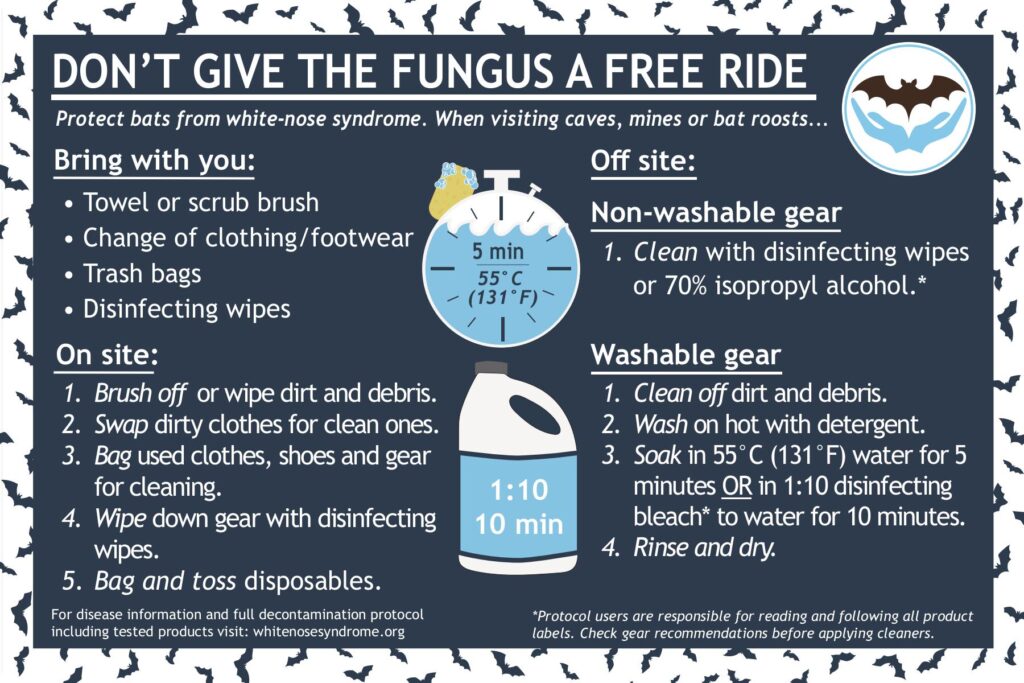
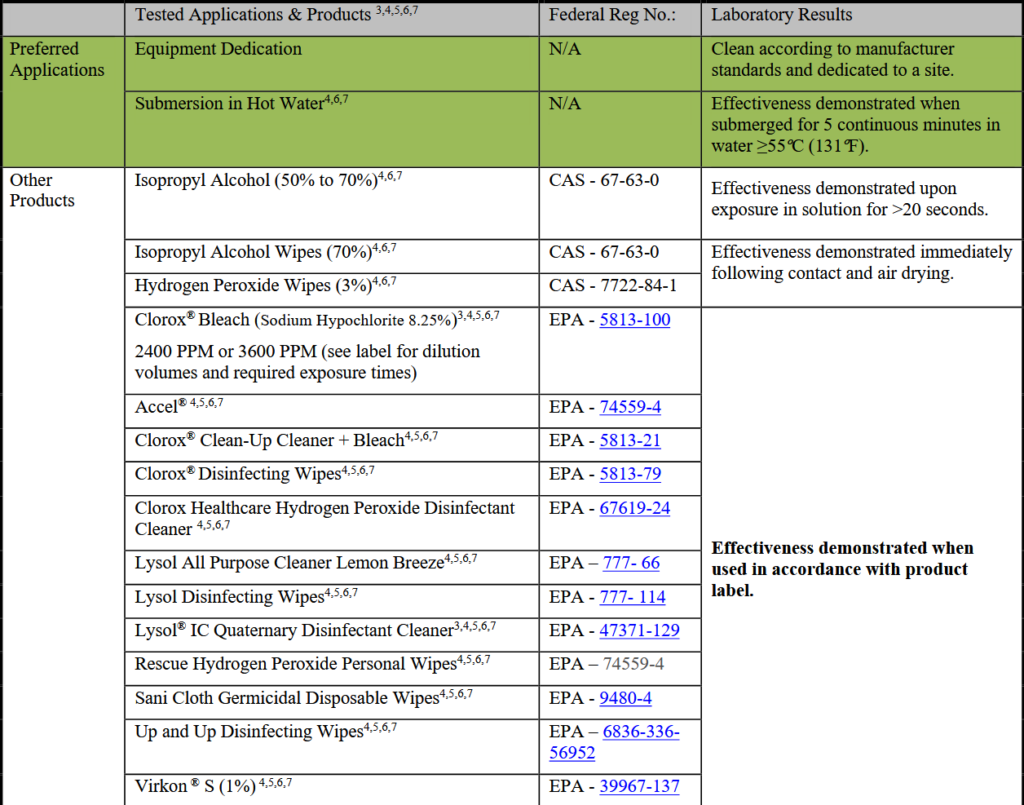
Decontamination Protocol – March 2024.
Safety Gear
Decontaminating safety gear has very limited information. Gear labels often limit cleaning to very mild methods insufficient for WNS decon. The following study is referenced in the 2024 WNS Decon Protocol which considered rope strength in it’s decontamination study.
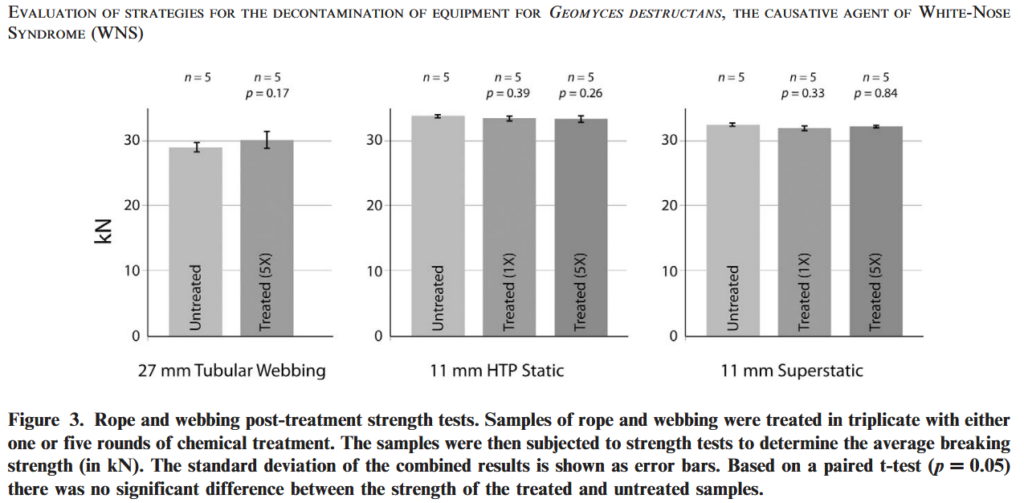
The study found washing in Woolite followed by a 10 minute soak in diluted Lysol IC (1:128) was very effective at decon and preserved rope and webbing strength.
Following quote and image sourced from:
V. Shelley, S. Kaiser, E. Shelley, T. Williams, M. Kramer, K. Haman, K. Keel, and H.A. Barton – Evaluation of strategies for the decontamination of equipment for Geomyces destructans, the causative agent of White-Nose Syndrome (WNS).
Journal of Cave and Karst Studies, v. 75, no. 1, p. 1–10. DOI: 10.4311/2011LSC0249
In addition to fabrics, speleologists use a number of pieces of critical life support equipment, including harnesses, webbing, and ropes. The nylon in this equipment gives the ropes or webbing strength; however, it is also susceptible to ionic attack, by substances such as bleach, which can damage the structural integrity and strength of the material. Consequently, we wanted to examine the ability of disinfection protocols to remove or kill spores on this material without harming its strength. Given the negative potential effects of bleach on nylon, we examined the ability of Woolite (which is traditionally used by speleologists to wash ropes) and Lysol IC (which can be made up in large volumes) to disinfect sewn webbing and nylon ropes. Treatment was carried out by washing in Woolite, rinsing with sterile water, soaking in a 1:64 dilution of Lysol IC for ten minutes, and rinsing twice in sterile water. The results demonstrated 100% killing of 2.5x10⁵ spores applied to rope and webbing samples (Table 5). A higher concentration of Lysol IC (1:64) was used to chemically stress the material, although a 1:128 dilution has been shown to be 100% effective in this assay. To test whether this altered the strength of the webbing or rope, we treated samples of one-inch tubular webbing, Sterling 11 mm HTP rope, and Sterling 11 mm Superstatic rope, for one or five rounds of treatment. The strength of these materials was then tested, and the average breaking strength (in kN) was recorded (Fig. 3). Similar rope tests have not been carried out on samples returned to other rope manufacturers despite repeated requests
Copyright © 2026 Southern Arizona Grotto. All rights reserved.